Saturday, December 3, 2022

How Truth Became an Illusion


Recommended: 
Granier, “Perspectivism and Interpretation” in Allison (ed.) The New Nietzsche
Nietzsche,  “Twilight of the Idols: How One Philosophizes with a Hammer” in Ecce Homo


Thursday, October 27, 2022

Master and Slave Morality

 Ressentiment and the Morality of Impotence

Nietzsche, On the Genealogy of Morals

— Part One

Recommended: Deleuze, “Active and Reactive” in Allison (ed.) The New Nietzsche; Babich, “The Genealogy of Morals and Right Reading”; Nietzsche, Ecce Homo: “On the Genealogy of Morals: A Polemic”


Thursday, October 20, 2022

Truth and Philosophy

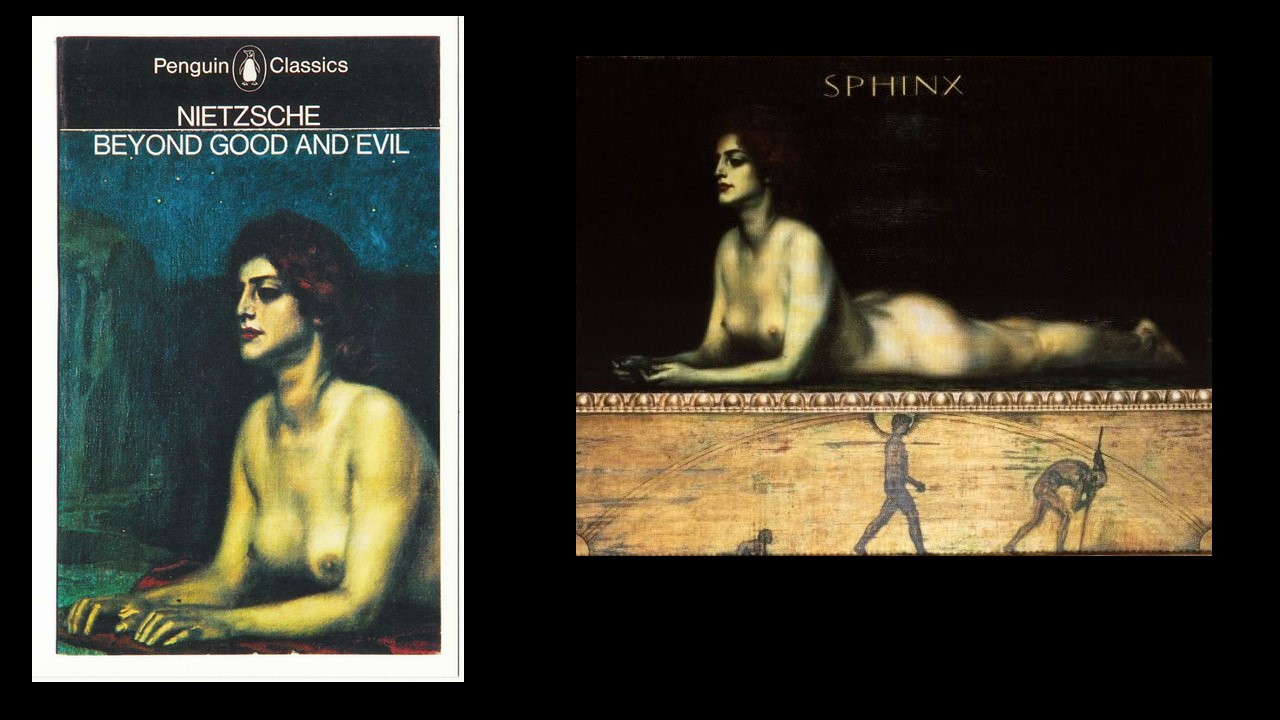
Nietzsche, Beyond Good and Evil


Recommended: 
Derrida, “Spurs”; Nietzsche, “On Truth and Lie in an Extra-Moral Sense” [Excerpt]; Kofman, “Metaphor, Symbol, Metamorphosis” first chapter in Nietzsche and Metaphor; Blanchot, “The Limits of Experience” in Allison (ed.) The New Nietzsche; Babich, “Nietzsche and the Ubiquity of Hermeneutics”

Nietzsche, Ecce Homo: “Beyond Good and Evil: Prelude to a Philosophy of the Future”


Saturday, October 15, 2022

Innocence and Parody: Decadence and Convalescence


Nietzsche, Thus Spoke Zarathustra; “Thus Spoke Zarathustra” in Reading the New Nietzsche

Recommended: 
Heidegger, “Who is Nietzsche’s Zarathustra”; Allison, “Who is Zarathustra’s Nietzsche”; Loeb, “The Rebirth of Nietzsche’s Zarathustra”; Haar, “Nietzsche and Metaphysical Language” in: Allison, ed., The New Nietzsche; Nietzsche, Ecce Homo: “Thus Spoke Zarathustra: A Book for All and None”
 

Tuesday, October 11, 2022

NIETZSCHE SOCIETY ANNUAL MEETING


9 AM: In Memoriam, Tracy Burr Strong
10 AM: Babette Babich: "Nietzsche's Ariadne"
11 AM: Daniel Conway:  "A Finishing School for Gentlemen? Revisiting Beyond Good and Evil"


Thursday, 13 October 2022: 9 AM-12 Noon
Texas A&M College Station, TX


Friday, September 30, 2022

The Gay Science: The Death of God and the Eternal Return

Nietzsche, The Gay Science (Books I-IV)

Recommended:

Allison, “The Gay Science”; Babich, “The Gay Science”; Klossowski, “Nietzsche’s Experience of the Eternal Return”; Strong, “The Doctrine of Eternal Return”; Nietzsche, ECCE HOMO: “The Gay Science (‘la gaya scienza’)”


Wednesday, September 14, 2022

History and the Invention of the Subject


Nietzsche,  “Uses/Disadvantages of History for Life” and 
“Schopenhauer as Educator” in Untimely Meditations

Recommended: Deleuze, “Nomad Thought”; Strong, “Parables of the Shepherd and the Herd: Nietzsche and Politics”; Babich, “Nietzsche’s Spiritual Exercises”; Nietzsche, Ecce Homo: “The Untimely Ones”

Monday, September 5, 2022

Tuesday, August 30, 2022

Nietzsche

Fordham University 

Fall 2022


Reading Nietzsche Reading Nietzsche

                        “Why I am so Wise” in: Ecce Homo


Recommended: Kofman, “Explosions 1”; Strong, “Approaching Nietzsche”; Allison, “Introduction”


Wednesday, October 10, 2018

Monday, December 18, 2017

Whose Eros?


Teaching, to paraphrase Nietzsche, is so erotic. 
But for whom? 
Whose eros if not the master’s erotic ideal: nor are we talking a student playground, youth on youth.
On this matter, Nietzsche stood in the company of the masters — professors, teachers.
...Hence Nietzsche could say, as he assured Lou Salomé in a protestation of his “intentions,” that he did not only seek someone to act as secretary and practical assistant in household affairs, he wanted a — she could be his — pupil. 
Lou, of course, never wanted to be so lucky.

Excerpt: Babich, Great Men, Little Black Dresses, & the Virtues of Keeping One’s Feet on the Ground, MP: An Online Feminist Journal. August 2010: Vol. 3, Issue 1, p. 76.

Friday, June 24, 2016

Mathematics

We are not used to reading Nietzsche on mathematics — although one of his earliest readers and admirers or should one say imitators, was indeed a topologist, Felix Hausdorff who wrote very intriguingly on Nietzsche’s landscapes and his Zarathustra.[1]  


Beyond what today’s (analytic) philosophers call ‘naturalism,” Nietzsche’s critical project of re-naturing the human precisely as all-too-human or in and from the humanly portioned or perspective is re-framed or reprised from the articulation in The Gay Science in Beyond Good and Evil where Nietzsche again emphasizes that his own goal remains the same transcriptive undertaking as that first advocated as the gay or musician’s science:
to translate man back into nature; to master the many vain and fanciful interpretations and secondary meanings which have been hitherto scribbled and daubed over that eternal basic text homo natura; to confront man henceforth with man in the way in which hardened by the discipline of science, man today  confronts the rest of nature, with dauntless Oedipus eyes and stopped-up Odysseus ears, deaf to the siren songs of old metaphysical birdcatchers who have all too long been piping to him >you are more! you are higher! you are of a different origin! (BGE §230)
It is rare that a commentator pauses to note that Oedipus eyes would be a miracle of nature, almost like Lyncaeus-eyes, very much like the kind of focus on sight and unseeing, on the sun and its blinding light that captivates philosophers after Plato.  Bataille will write on this in his own voice, as will Lacan and with respect to Nietzsche, Bernard Pautrat and Henri Birault. 
And Odysseus ears present an even greater challenge for Horkheimer and Adorno.


[1] Felix Hausdorff importantly also echoes Nietzsche’s anthropocentric critique of science as of mathematics, writing under the pseudonym of Paul Mongré, and highlighting the very radical point Nietzsche makes at this locus: “We lack a self-critique of science; judgements of art, of religion, of feelings about science are as many in number as they are useless. Maybe this is the last destiny of mathematics!” Mongré, Sant’ Ilario § 401.  Thus the last section of Mongré’s/Hausdorf’s collection of aphorisms is entitled “Towards a Critique of Knowing.”  

(For a discussion of Hausdorff and Nietzsche, see Schulz, “Felix Hausdorff and the Hausdorff Edition” as well as Stegmaier, “Ein Mathematiker in der Landschaft Zarathustras.”)